Greece’s energy transition: from lignite to solar, and what comes next
For half a century Greek electricity came mostly from lignite. Within a decade the mix turned to gas, wind and solar, leaving a grid with surplus power at midday and a gap every evening.
Half a century of lignite
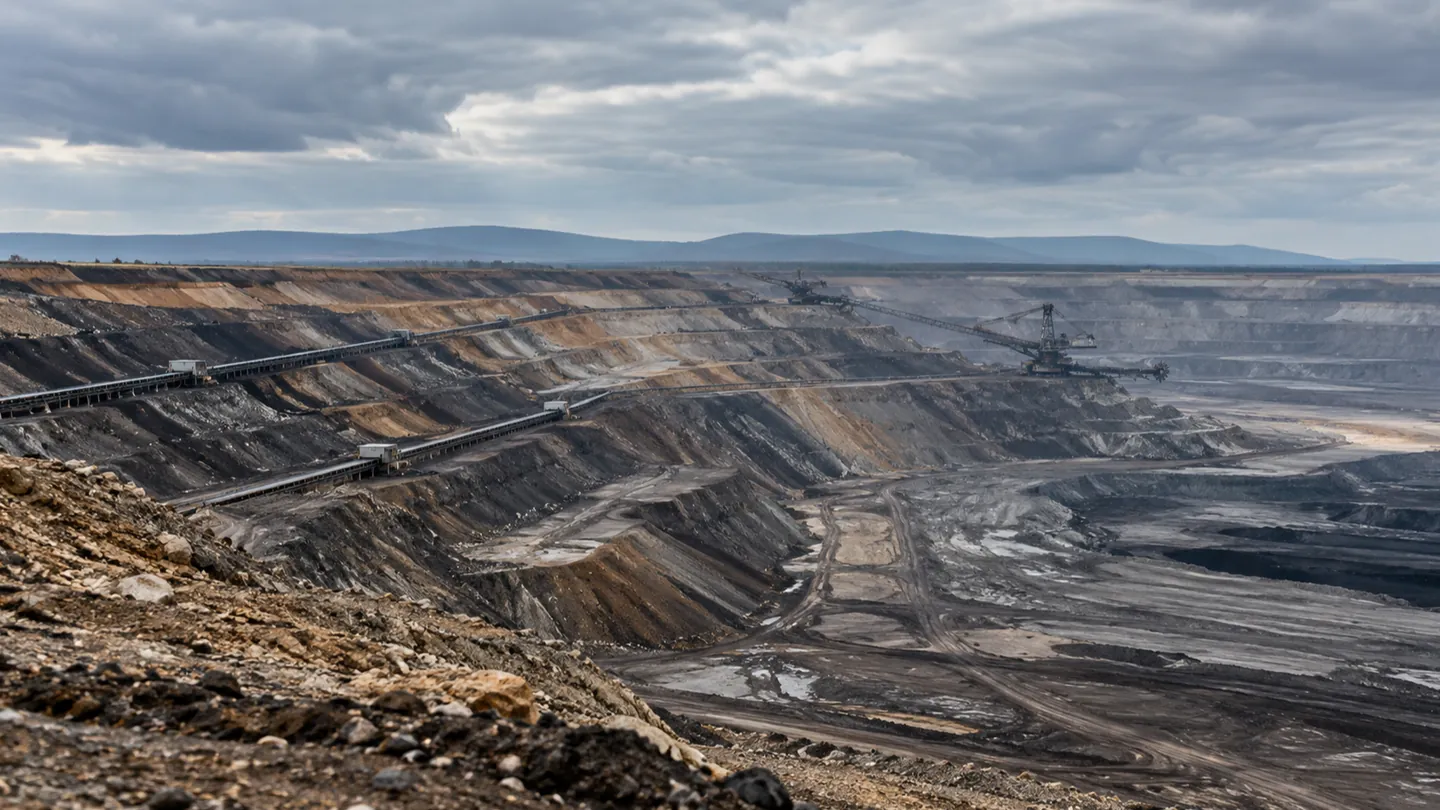
The Public Power Corporation (PPC, in Greek DEI) was founded under Law 1468/1950 to build and operate hydroelectric and thermal power stations1. The aim was a national generating system, and the fuel to hand lay under the ground of Western Macedonia and Megalopoli: lignite.
For decades lignite was domestic, cheap to mine and available around the clock. Towns, mines and a whole regional economy grew up around it. In 1990 it supplied 71.9 %2 of the country’s gross electricity generation2.
The price was emissions. Lignite is a wet, low-calorific coal, so a lot of material is burned for each kilowatt-hour. That means a lot of carbon dioxide and, locally, particulates and ash, which the surrounding areas lived with for years.
Islands, oil and subsea cables
Islands that were not connected to the mainland system generated their own power in local oil-fired stations. Each was a small, separate grid that had to balance itself.
The answer has been subsea cables. Crete’s first interconnection ran to the Peloponnese, and on 3 July 2021 the mainland system began supplying the island3. The Crete–Attica interconnection entered trial operation on 24 May 20254.
Gas and the first renewables
During the 1990s natural gas went from an almost zero share to a significant source, and from the 2000s wind power grew as well2. Even so, in 2010 lignite and coal still supplied 53.6 %2 of gross generation2: less than before, but still the base of the system.
Gas had two advantages lignite lacked. It emits less carbon dioxide per kilowatt-hour, and modern gas units ramp output up and down quickly. The second would become its most valuable feature.
The 2019 pledge
On 23 September 2019, at the UN Climate Action Summit, the Prime Minister announced that Greece aimed to close all of its lignite-fired power units by 2028, even though it is a major lignite producer5.
By then lignite had already fallen to 24.9 %2 of generation2. Under the EU Emissions Trading System every tonne of carbon dioxide has to be paid for, and the fuel with the highest emissions per kilowatt-hour is the first to lose its economics.
The revised NECP of 2024 kept the date. It states that all lignite units will be withdrawn by 2028 in an orderly way, with Ptolemaida 5 as the last unit6.
Where the mix stands today
In 2024 lignite supplied just 5.6 %2 of gross generation and solar 19.4 %22. For 2025, monthly net generation data give natural gas 44.5 %7, wind 20.2 %7 and solar photovoltaics 17.1 %7.
Solar grew fastest. In May 2026 installed photovoltaic capacity on the interconnected system and distribution network exceeded 11.6 GW88, before counting the islands that are not yet connected. That is good news for emissions and for the bill for imported fuel. It also brings a problem that did not exist when power came from lignite: all that solar produces at the same hours, and those are not the hours when the system needs the most power.
The NECP target for 2030 is for renewables to cover 75.7 %6 of gross electricity consumption6. Lignite and coal supplied 71.9 %2 of Greece’s gross electricity generation in 1990 and 5.6 %2 in 2024, when solar alone supplied 19.4 %22.
Too much at noon, too little after sunset
Generation must match consumption at every moment. When, on a sunny spring midday, solar produces more than the country consumes and exports, the system operator asks renewable stations to reduce output. This is curtailment: energy that could have been produced at almost zero variable cost is thrown away.
The Independent Power Transmission Operator (IPTO, known in Greek as ADMIE) publishes monthly curtailment reports. We have not found an official annual total in a form that can be cited here, and we do not adopt the figures that circulate in the press. When an official total is available, it will be added with its source.
Peak demand in 2025 was 10,370 MW9, early in the afternoon of 25 July9, when solar was still helping. The more demanding hour comes a little later: the sun sets, consumption stays high, and within a short time other sources must replace what solar was providing.
Today that job falls mainly to gas units and hydropower, which ramp quickly, and to interconnections with neighbouring countries. In 2025 Greece imported 3.4 TWh10 and exported 6.4 TWh10, which made it a net exporter. The flows change direction within the day, though, and in the evening imports help. The wider regional picture is covered in nuclear power in Greece’s neighbourhood.
Storage, and what it leaves uncovered
The obvious fix is to store midday power and release it in the evening. Greece’s first battery tender selected projects totalling 411.79 MW1111, and the three tenders together selected 900.47 MW12 across 32 stations12.
The revised NECP projects for 2030 4.3 GW6 of battery storage and 1.9 GW6 of pumped storage, in which water is pumped to an upper reservoir when power is in surplus and released through turbines when it is short6.
Batteries solve the problem of a few hours. They do not solve windless, overcast winter days, which need either far more storage or a source that produces whenever required. In a solar-heavy system the most valuable megawatt-hours are the ones the sun cannot supply: at night, in winter, in calm weather. Today they come mainly from imported natural gas.
This is where the nuclear debate enters, as one option for those hours alongside storage and interconnections. Nuclear offers steady output with no direct emissions in operation, but it has its own limits: it changes output more slowly than gas, it is expensive to build and it takes many years to bring into service. No decision to build a plant has been taken; where Greece stands sets out the current position. The Greek section of this site also has an interactive grid game (in Greek) that shows the problem in 72 seconds.
Frequently asked questions
Are all of Greece’s lignite plants really closing?
The revised 2024 NECP provides for the withdrawal of all lignite units by 2028, with Ptolemaida 5 the last. Whether the timetable holds will be seen in practice, and this page will be updated.
Why do the percentages here differ slightly from others I have read?
There are two measures. Gross generation counts everything the generators produce; net generation subtracts what the power stations consume themselves. The historical series here is gross and annual, while the 2025 figures are net and monthly. Both come from Eurostat.
Why not simply install more batteries?
They are being installed, and the NECP projects battery capacity for 2030. Batteries are economic for a few hours of storage. Covering days or weeks of little sun and little wind needs many times the capacity, and there the cost rises steeply.
The editor works as an engineer in the nuclear sector. Views here are his own and do not represent any employer. The platform receives no funding from anyone. Not yet independently reviewed by a second engineer. Read in Greek.
Sources
- Εθνικό Τυπογραφείο · ΦΕΚ Α΄ 169/07.08.1950, άρθρ. 1 §1. Νόμος 1468/1950 «Περί ιδρύσεως δημοσίας επιχειρήσεως ηλεκτρισμού». Tier 1 primary official — published 1950-08-07 · retrieved 2026-10-14
- Eurostat · nrg_bal_peh — ετήσια ακαθάριστη ηλεκτροπαραγωγή ανά καύσιμο, geo=EL, 1990–2024. Production of electricity and derived heat by type of fuel (nrg_bal_peh). Tier 1 primary official — published 2026-06-02 · retrieved 2026-10-14
- ΑΔΜΗΕ · Δελτίο τύπου, 03/07/2021. Successful power supply to Crete through IPTO's new interconnection. Tier 1 primary official — published 2021-07-03 · retrieved 2026-10-14
- ΑΔΜΗΕ · Δελτίο τύπου, 26/05/2025. Σε λειτουργία η ηλεκτρική διασύνδεση Κρήτης-Αττικής. Tier 1 primary official — published 2025-05-26 · retrieved 2026-10-14
- Γραφείο Πρωθυπουργού · primeminister.gr, 23/09/2019. Ομιλία του Πρωθυπουργού Κυριάκου Μητσοτάκη στη Σύνοδο Κορυφής για το Κλίμα. Tier 1 primary official — published 2019-09-23 · retrieved 2026-10-14
- Υπουργείο Περιβάλλοντος και Ενέργειας · ΕΣΕΚ, Αθήνα, Αύγουστος 2024 (υποβολή στην Ευρωπαϊκή Επιτροπή, δημοσίευση 07/01/2025). Εθνικό Σχέδιο για την Ενέργεια και το Κλίμα — Αναθεωρημένη Έκδοση. Tier 1 primary official — published 2024-08-01 · retrieved 2026-10-14
- Eurostat · nrg_cb_pem. Net electricity generation by type of fuel — monthly data (nrg_cb_pem). Tier 1 primary official — published 2026-08-14 · retrieved 2026-08-15
- ΔΑΠΕΕΠ · Σ. 6, πίνακας «Εγκατεστημένη ισχύς μονάδων ΑΠΕ (MW)», γραμμή Φ/Β, σύνολο διασυνδεδεμένου συστήματος και δικτύου. Μίνι Μηνιαίο Απολογιστικό Δελτίο Ειδικού Λογαριασμού ΑΠΕ, ΣΗΘΥΑ & Αποθήκευσης — Μάιος 2026. Tier 1 primary official — published 2026-08-25 · retrieved 2026-10-14
- ENTSO-E · Σ. 7, «Highest and lowest hourly load values for 2025», γραμμή GR. Statistical Factsheet 2025 (provisional). Tier 1 primary official — published 2026-07-01 · retrieved 2026-10-14
- Eurostat · nrg_cb_em. Supply, transformation and consumption of electricity — monthly data (nrg_cb_em). Tier 1 primary official — published 2026-08-14 · retrieved 2026-08-16
- ΡΑΑΕΥ · ΑΔΑ Ε63ΨΙΔΞ-Μ7Χ, σ. 6–7, Πίνακας 1. Απόφαση Ε-130/2023: Οριστικός κατάλογος της πρώτης ανταγωνιστικής διαδικασίας για σταθμούς αποθήκευσης. Tier 1 primary official — published 2023-08-10 · retrieved 2026-10-14
- ΡΑΑΕΥ · Παρουσίαση, 89η ΔΕΘ, Σεπτέμβριος 2025, διαφάνειες 13–14. Η ανάπτυξη των συστημάτων αποθήκευσης στην Ελλάδα. Tier 1 primary official — published 2025-09-11 · retrieved 2026-10-14
Every figure on this page links to its source and the date it was retrieved. Original titles are kept in their own language. If something does not add up, tell us.
Read next