Greece’s nuclear regulator: what the EEAE does today and what would have to change
Greece has no nuclear power plant, but hospitals, laboratories and factories use ionising radiation every day. Oversight belongs to the Greek Atomic Energy Commission (EEAE), a public-law legal entity with full administrative and financial autonomy, within a European framework. This explainer sets out what it oversees now and what a power programme would demand of the regulator.
What a regulator actually does
A regulator operates nothing. It does not build installations, sell electricity or examine patients. Its work starts where someone else wants to use ionising radiation: it sets the rules, decides who may work with radiation and on what terms, checks on site that the terms are kept, and intervenes when they are not.
The rules turn principles into checkable requirements. Justification: a practice involving radiation is allowed only when its benefit outweighs the harm it may cause. Optimisation: once allowed, exposure is kept as low as reasonably achievable. Dose limits set a ceiling for workers and the public. The regulation states the objective; proving it is met is the applicant’s job.
In licensing, the applicant submits a file: what it will do, with which equipment and trained staff, under which procedures, what could go wrong and what happens then. The regulator does not design the solution; it judges whether the case stands up. A licence comes with conditions and a fixed term, and any substantial change goes back for assessment.
Inspection, scheduled and unannounced, shows whether the file describes reality. Enforcement is graduated, from a recommendation through a compliance timetable, extra conditions and fines to suspension or revocation of the licence and an order to stop operating. Without that last step, a rule becomes advice and the system depends on the goodwill of those it regulates.
Why independence is a precondition, not a detail
A regulator’s independence is judged in two directions: from the operator, and from the political authority that promotes or funds a technology. The first is obvious: the party being checked cannot pay, appoint or house the office that checks it, or saying "no" costs the person who says it.
Distance from political promotion is less visible and just as critical. When the same ministry promotes a technology and judges whether it is safe, the roles pull apart: promotion wants a timetable and no bad news, oversight wants evidence, time and the freedom to say something has not yet been demonstrated. A regulator carrying both will consistently give way to the one with political backing.
Independence is secured by mechanisms, not statements. They include:
- Its own budget, with income that does not depend on the outcome of a decision.
- Its own staff, with technical competence that is not borrowed from the licensee.
- Fixed terms of office with grounds for removal set in advance.
- Legal power to refuse without prior approval from anyone else.
- Publication of decisions and the reasons for them, so that pressure leaves a trace.
Safety, security and safeguards are different problems
In everyday Greek, one word, asfaleia, covers both safety and security. The sector separates them, and adds a third problem, because each needs different skills and often different people. Safety deals with what can go wrong without intent, from equipment failure and human error to earthquake or loss of cooling; its tool is defence in depth, successive independent barriers so that no single failure leads to a release. Security is defence against deliberate action: sabotage, theft of a source, intrusion into control systems, the insider threat. Safeguards verify, through material accountancy, seals and international inspection, that nuclear material is not diverted to non-peaceful uses.
Safety works better with transparency: the more people read an analysis, the more likely someone finds the gap. Security works with confidentiality, because a published weakness becomes instructions for an adversary who adapts to your measures. The same organisation has to hold both, with a clear rule on what is published, without using security as a pretext to hide safety findings.
Safeguards concern countries without power plants too, because nuclear material exists in research and other uses, and a non-proliferation commitment is verified rather than taken on trust.
What is regulated in Greece today
Greece has no nuclear power plant. Radiation protection there covers mainly medicine and industry, plus research, the transport of radioactive material and environmental monitoring. Research uses include the research reactor at NCSR "Demokritos", whose history and current status are covered in a separate article. Instead of a few large installations, the risk lies in many small sources scattered across hospitals, laboratories, construction sites and factories.
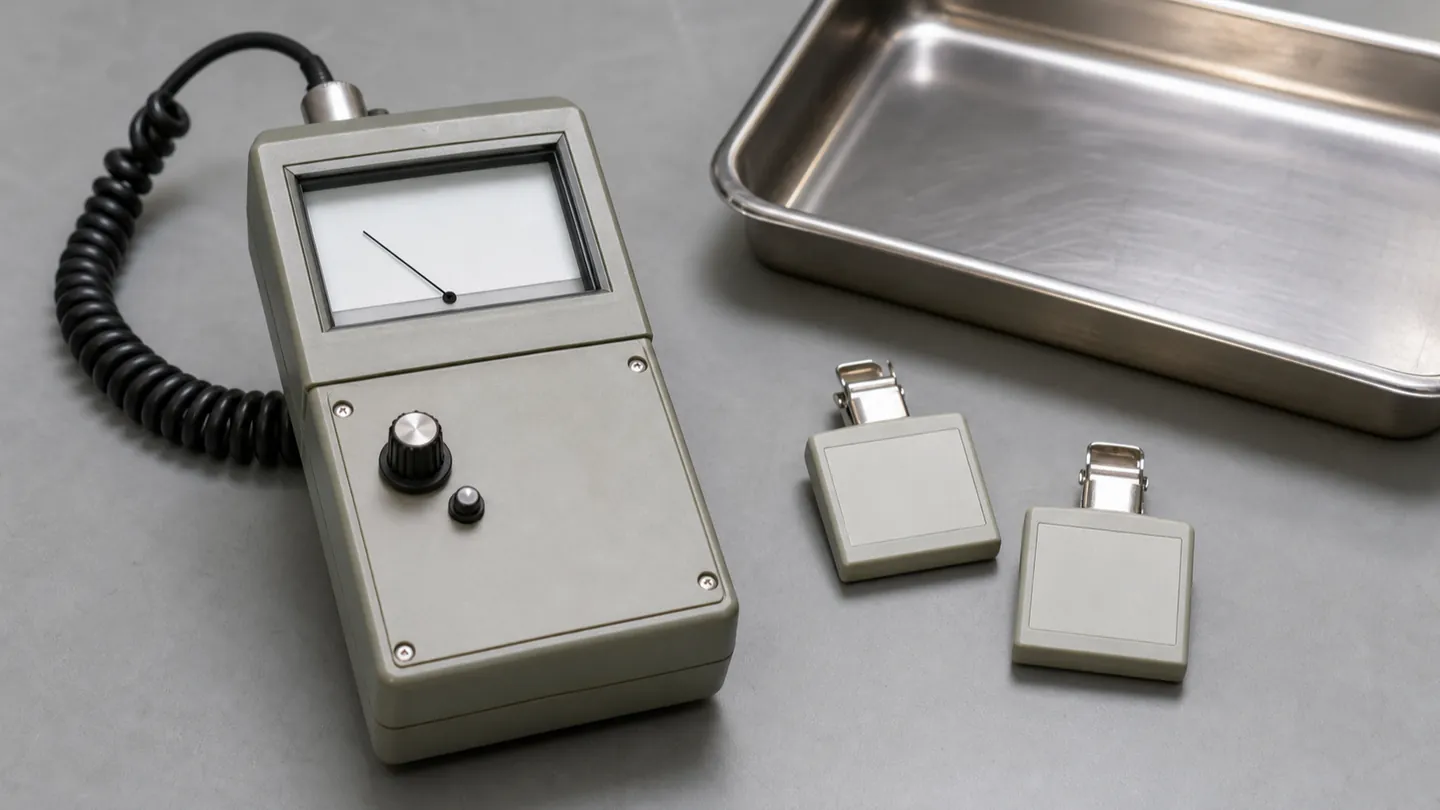
Medical use, from diagnostic radiology and CT to nuclear medicine and radiotherapy, is the largest man-made source of exposure for the population. Oversight here covers the justification of each examination, acceptance testing and periodic quality control of the equipment, dosimetry for staff, training, and the duty to report any unintended or significantly deviating exposure. In radiotherapy, harm can come from underdosing as well as overdosing, because the aim is to treat.
In industry, sources are used for radiography on construction sites and in refineries, for level and thickness gauges, for sterilising materials and for logging boreholes. The realistic incident is a source that is lost or stolen, left exposed because it was never returned to its shielding, or carried off in a load of scrap metal to a steelworks.
Part of the work cannot be tied to any licence: monitoring environmental radioactivity, checking food and imported cargo, and preparing for an event in another country. For a country without a plant, that is the realistic route by which a major radiological event would reach it, so measurement capacity and public information are part of the job.
The EEAE and the framework it works within
The competent national authority for radiation protection and nuclear safety in Greece is the Greek Atomic Energy Commission (EEAE). It is a public-law legal entity with full administrative and financial autonomy (Law 4310/2014, as amended by Laws 4982/2022 and 5019/2023), and the law explicitly designates it as the competent regulatory authority for the control, regulation and supervision of nuclear energy, radiological and nuclear safety, and radiation protection. It does not operate any energy installation. The national framework for the nuclear safety of nuclear installations is Presidential Decree 60/2012, and Ministerial Decision P/112/305/2012 applies to research reactors.1 Its work covers the radiation protection framework, licensing and registration of practices using ionising radiation, inspection and enforcement, staff dosimetry and instrument calibration, environmental monitoring, radiological emergency preparedness, training, and the role of national contact point for international organisations and other states. It also takes part in physical protection and safeguards, to the extent the national and European framework provides; safeguards inspections are carried out by the IAEA and Euratom. Exact competences, organisational form and the texts in force change over time, so the authority’s own official description and the Government Gazette (FEK) are the only safe reference for what applies today.
Greek regulation rests on the Euratom Treaty and the directives issued under it: the basic safety standards for protection against ionising radiation, the directive on the nuclear safety of nuclear installations, and the directive on the responsible management of spent fuel and radioactive waste. These set minimum requirements, are transposed into national law and bind a member state whether or not it produces nuclear power. One requirement running through them is a competent authority functionally independent of bodies that promote or operate the activity concerned. The framework also brings periodic national reports, topical peer reviews among member states and coordination among European regulators, which expose the national system to questions from people with no reason to flatter it.
Above the European level sits the international one. The IAEA publishes safety standards that serve as a common language, reviews a country’s regulatory framework at that country’s invitation, and verifies safeguards. The conventions on early notification of a nuclear accident and on emergency assistance are why information crosses borders quickly, which matters more to Greece than to countries with their own units.
The energy mix remains a national competence, so no country is obliged to adopt or abandon nuclear generation. The European framework sets out how, not whether. Nuclear is included in the EU Taxonomy only under strict conditions on waste, safety and timelines; it is a low-emission, dispatchable source, not a renewable one.
What would have to change if a power plant were ever considered
Debate about a nuclear power plant usually starts with technology and cost. Institutionally, the first thing to change would be the regulator itself, long before any concrete is poured. Overseeing medical and industrial sources and overseeing a power plant share principles, not skills: the second needs safety and probabilistic analysis, thermal hydraulics, seismic justification, materials and ageing, human factors, and supervision of construction and the supply chain. Building that capability is a decade-scale effort, and the regulator has to be ready before the project, not chase after it.
A government committee on nuclear energy has been set up by a Cabinet Act (Act 28/2026); it recommends, the Cabinet decides, and no decision to build has been taken. If the question were pursued, the prerequisites would include:
- Separate staged licensing legislation, with distinct decisions on siting, construction, operation, each substantial modification and finally decommissioning, each with its own criteria and its own power to refuse.
- Environmental impact assessment, public consultation with real access to documents, and transboundary consultation with neighbours, which for Greece’s geography is not a formality.
- A national policy and plan for spent fuel and radioactive waste, with a management body institutionally separate from both the regulator and the generator.
- Decommissioning funding secured in advance, so that the cost does not fall on the state once the plant stops earning.
- Adequate insurance cover and financial security for third-party damage at power-plant scale. Greece is already a party to the Paris Convention on Third Party Liability in the Field of Nuclear Energy and its 2004 amending Protocol (Law 3787/2009, in force), so the open question is the adequacy of cover, not ratification.
- An emergency preparedness system with planning zones, regular exercises and operational bodies that have been tested, not merely designated on paper.
Independence under a live project
With a power project in view, the independence question gets harder. A project that carries political backing and a timetable puts the regulator under far greater pressure. Funding from licensing fees would have to be designed so that income does not depend on approval, and the dual role of promotion and oversight would have to be explicitly prohibited. None of this concerns the choice of technology or implies any location; these are prerequisites settled before any technical discussion. Whether the wider system could carry them is examined in Can Greece support a nuclear programme?
An outside observer can check signs that need no technical knowledge: whether decisions are published with their reasoning, whether inspection findings and incidents appear alongside reassurances, and whether peer-review recommendations are published and followed up. The clearest sign is whether the authority has ever refused something at a real cost to the applicant. A regulator that has never stopped, suspended or refused anything is either overseeing a sector without problems or not looking.
Frequently asked questions
Does Greece have a nuclear power plant?
No. Radiation protection in Greece today concerns mainly medical applications, industrial sources, research and teaching uses, the transport of radioactive material and monitoring of radioactivity in the environment. Regulatory control exists regardless of whether nuclear power is generated, because sources of ionising radiation are used daily in hospitals and production plants.
Why does a country without nuclear power need an independent regulator?
Because the population’s exposure to man-made radiation comes mainly from medical examinations and treatment, and because industrial sources can cause serious harm when they are lost or misused. The country also needs the capacity to measure and respond to an event in another country, which is the realistic route by which a major radiological event would affect Greece.
Would today’s structure be enough if a power plant were ever decided?
Not in its present form. It would need a different scale and a different kind of technical competence, separate staged licensing legislation, a national plan for radioactive waste and spent fuel with a separate management body, secured decommissioning funding, adequate civil liability cover for a power plant (Greece is already a party to the Paris Convention and its 2004 Protocol) and a tested preparedness system. Developing these is a decade-scale effort, and they have to be in place before the project.
The editor works as an engineer in the nuclear sector. Views here are his own and do not represent any employer. The platform receives no funding from anyone. Not yet independently reviewed by a second engineer. Read in Greek.
Sources
- Ελληνική Επιτροπή Ατομικής Ενέργειας (ΕΕΑΕ) · CNS 2022 Greece National Report. Greek National Report under the Convention on Nuclear Safety. Tier 1 primary official — published 2022-01-01 · retrieved 2026-08-16
Every figure on this page links to its source and the date it was retrieved. Original titles are kept in their own language. If something does not add up, tell us.
Read next